
What is Corporate Culture? The Definitive Guide
what is corporate culture

What is Corporate Culture? The Definitive Guide

Unlock the power of a strong company culture to drive performance, attract talent, and foster innovation within your organization.

Define Your Culture

Key Takeaways

  • ✓ Corporate culture is the shared values, beliefs, behaviors, and norms that characterize an organization.
  • ✓ It significantly impacts employee satisfaction, retention, and overall business performance.
  • ✓ Culture is not static; it evolves and can be intentionally shaped by leadership.
  • ✓ A strong, positive culture can be a significant competitive advantage.

How It Works

1
Define Your Core Values

Identify the fundamental principles that guide your organization's decisions and actions. These values should be authentic and reflect the company's mission.

2
Communicate and Model Behaviors

Clearly articulate your cultural expectations to all employees and ensure leaders consistently exemplify these behaviors. Actions speak louder than words in shaping culture.

3
Integrate Culture into Processes

Weave cultural values into hiring, onboarding, performance management, and reward systems. This reinforces desired behaviors and ensures alignment.

4
Measure, Adapt, and Evolve

Regularly assess the health of your culture through surveys and feedback. Be prepared to adapt and evolve your approach based on insights and changing business needs.

Understanding the Fundamentals of Organizational Culture

Multiracial colleagues in formal clothes sitting at table with laptop and documents while discussing details of business plan Photo: Sora Shimazaki / Pexels
At its core, understanding what is corporate culture means grasping the invisible force that shapes every aspect of an organization's existence. It's the collective personality of a company – a blend of shared values, beliefs, attitudes, and practices that influence how employees interact with each other, with customers, and with the outside world. Think of it as the unwritten rulebook, the 'way we do things around here.' This isn't just about perks or office aesthetics; it delves much deeper into the very soul of a business. It dictates decision-making processes, communication styles, problem-solving approaches, and even how success is defined and celebrated. A well-defined and positive corporate culture can be a powerful engine for growth, innovation, and employee satisfaction, while a toxic or undefined culture can lead to high turnover, low morale, and ultimately, business failure. It’s the difference between a place where people thrive and a place where they merely survive. Delving further, corporate culture is multifaceted, encompassing various dimensions. These include the company's mission and vision, its ethical standards, the degree of autonomy given to employees, the emphasis on teamwork versus individual achievement, and the approach to risk-taking. For instance, a tech startup might foster a culture of rapid innovation, flat hierarchies, and constant experimentation, whereas a financial institution might prioritize stability, compliance, and structured processes. Neither is inherently better; what matters is alignment with the company's strategic objectives and its people. The elements that constitute a culture are often subtle and can be hard to articulate, yet their impact is profound and palpable. They are observed in daily interactions, reflected in leadership styles, and reinforced through organizational rituals and stories. Recognizing these underlying dynamics is the first step toward intentionally shaping a culture that supports your business goals. It's a continuous journey of observation, reflection, and strategic intervention. Understanding the intricacies of organizational behavior is crucial for any leader aiming to foster a thriving workplace. The impact of culture extends beyond internal operations, influencing a company’s public image and its ability to attract top talent. A strong, positive culture acts as a magnet, drawing individuals who resonate with the company's values and mission, thereby creating a self-reinforcing cycle of success. Conversely, a poor culture can repel talent, leading to a constant struggle to fill key positions and maintain institutional knowledge. Therefore, investing in understanding and cultivating culture is not merely a soft HR initiative; it is a strategic imperative for long-term sustainability and competitive advantage. Learn more about corporate strategy.

The Indispensable Role of Corporate Culture in Business Success

Happy colleagues celebrating a birthday in an office with hats and balloons. Photo: RDNE Stock project / Pexels
The significance of corporate culture cannot be overstated in today's competitive landscape. It’s no longer a 'nice-to-have' but a critical component of sustainable business success. A strong, positive culture directly correlates with increased employee engagement, higher productivity, reduced turnover, and enhanced customer satisfaction. Employees who feel connected to their company's values and mission are more motivated, committed, and willing to go the extra mile. They become brand ambassadors, both internally and externally, contributing to a positive public image and a strong employer brand. This, in turn, makes the organization more attractive to top talent, creating a virtuous cycle of growth and success. Consider the impact on employee retention: when employees feel valued, respected, and aligned with their workplace, they are far less likely to seek opportunities elsewhere. This reduces recruitment costs, preserves institutional knowledge, and fosters a stable, experienced workforce that can drive innovation and operational excellence. Furthermore, corporate culture plays a pivotal role in shaping decision-making at all levels. In organizations with strong ethical cultures, employees are more likely to make choices that align with the company's values, even when faced with difficult situations. This can prevent reputational damage, legal issues, and financial losses. Culture also influences how an organization adapts to change. A flexible, agile culture encourages innovation and resilience, allowing the company to pivot quickly in response to market shifts or technological advancements. Conversely, a rigid, change-averse culture can stifle progress and leave an organization vulnerable. Beyond internal dynamics, culture profoundly impacts customer perception and loyalty. Employees who are engaged and happy are more likely to provide exceptional customer service, leading to positive customer experiences and repeat business. Companies like Southwest Airlines are often cited for their strong, employee-centric cultures that translate directly into outstanding customer service. Ultimately, investing in and nurturing a robust corporate culture is an investment in the entire ecosystem of the business, yielding returns far beyond mere financial metrics. It builds a resilient, dynamic, and human-centric organization capable of navigating challenges and seizing opportunities in an ever-evolving market. It's about creating an environment where people feel empowered to do their best work, knowing their contributions are valued and meaningful.

Key Elements and Dimensions of a Thriving Corporate Culture
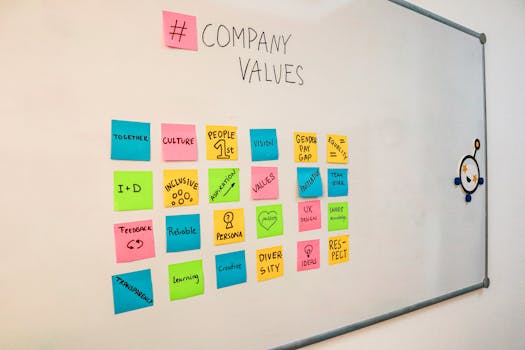
A whiteboard featuring colorful sticky notes outlining company values and teamwork principles. Photo: Walls.io / Pexels
To truly understand what is corporate culture, one must dissect its key components. A thriving corporate culture is built upon several foundational elements, each contributing to the overall organizational personality and operational flow. Firstly, **Shared Values and Beliefs** are the bedrock. These are the core principles that guide employee behavior and decision-making. They define what the company stands for, its ethical compass, and its priorities. For example, a company might value innovation, integrity, customer-centricity, or collaboration above all else. These values should be clearly articulated, consistently communicated, and genuinely lived by leadership. Secondly, **Leadership Style** is a powerful determinant. The way leaders interact with employees, make decisions, and manage conflicts significantly shapes the culture. Authoritarian leaders tend to foster hierarchical, fear-driven cultures, while transformational leaders often cultivate empowering, innovative environments. Leaders must embody the desired culture and serve as role models for the entire organization. Their actions, more than their words, define the cultural reality. Thirdly, **Communication and Transparency** are vital. An open, honest, and frequent flow of information fosters trust and reduces speculation. Companies with strong cultures often have multiple channels for communication – from town halls to anonymous feedback systems – ensuring that employees feel heard and informed. Transparency around company performance, challenges, and strategic direction empowers employees and builds a sense of shared ownership. Fourthly, **Work Environment and Physical Space** can subtly yet powerfully influence culture. An open-plan office might encourage collaboration, while private offices might foster focused individual work. The availability of breakout spaces, wellness rooms, or even the decor can reflect and reinforce cultural values. However, it's crucial to remember that the physical space is a reflection, not the sole driver, of culture. Fifth, **Employee Recognition and Rewards** systems play a significant role. How accomplishments are celebrated and how employees are compensated and recognized for their contributions sends clear signals about what is valued within the organization. A culture that celebrates both individual and team successes, and rewards behaviors aligned with its values, reinforces those values powerfully. Finally, **Rituals and Traditions** contribute to the unique fabric of a culture. These can be anything from weekly team lunches and annual company retreats to specific onboarding processes or celebratory customs. These shared experiences create a sense of belonging and reinforce collective identity. Each of these elements, when thoughtfully designed and consistently implemented, contributes to a cohesive and impactful corporate culture. Understanding their interplay allows organizations to intentionally build a culture that attracts, retains, and motivates its workforce, ultimately driving superior business outcomes. It’s an ongoing process of nurturing and refinement, ensuring that the culture remains dynamic and aligned with the evolving needs of the organization and its people. Discover best practices in corporate governance.

Cultivating and Sustaining a Positive Corporate Culture: Tips and Pitfalls

Diverse group enjoying team building games outdoors with joyful expressions. Photo: RDNE Stock project / Pexels
Cultivating a positive corporate culture is a continuous journey, not a destination. It requires intentional effort, consistent reinforcement, and a willingness to adapt. Here are some key tips and common pitfalls to avoid: **Tips for Cultivating a Positive Culture:** * **Define and Live Your Values:** Don't just publish values; embed them into daily operations, hiring, performance reviews, and leadership behaviors. They must be authentic. * **Lead by Example:** Leaders are the primary culture carriers. Their actions, attitudes, and decisions set the tone for the entire organization. Inconsistency from leadership is a major culture killer. * **Prioritize Communication:** Foster open, transparent, and frequent communication. Encourage feedback, listen actively, and provide clear channels for employees to voice concerns and ideas. * **Invest in Employee Development:** Show your commitment to employees by providing opportunities for learning, growth, and career advancement. This demonstrates that you value their future. * **Recognize and Reward:** Acknowledge and celebrate achievements, both big and small. Tie recognition to desired cultural behaviors to reinforce them. * **Promote Work-Life Balance:** Encourage healthy boundaries between work and personal life. A burnt-out workforce cannot sustain a positive culture. * **Foster Inclusivity and Diversity:** Create an environment where every individual feels respected, valued, and has an equal opportunity to contribute and succeed. * **Onboard for Culture:** Integrate cultural immersion into your onboarding process. Help new hires understand 'the way we do things here' from day one. **Common Pitfalls to Avoid:** * **Culture by Accident:** Allowing culture to form organically without strategic guidance often leads to a fragmented or toxic environment. * **Ignoring Feedback:** Dismissing employee surveys or direct feedback signals a lack of care and can quickly erode trust and morale. * **Hypocrisy in Leadership:** Leaders preaching one thing but doing another creates cynicism and undermines all cultural initiatives. * **Focusing Only on Perks:** While perks are nice, they are not a substitute for a fundamentally healthy culture. A foosball table won't fix a toxic manager. * **Lack of Accountability:** Failing to address behaviors that violate cultural values sends a message that values are not truly important. * **Static Culture:** Believing culture is a fixed entity. Organizations and their environments evolve, and so too must the culture, requiring constant attention and adaptation. * **One-Size-Fits-All Approach:** What works for one team or department might not work for another. Be sensitive to subcultures while maintaining core organizational values. By proactively addressing these areas, organizations can build and sustain a vibrant, resilient culture that supports both employee well-being and business objectives.

Comparison

AspectStrong CultureWeak/Toxic CultureNeutral/Undefined Culture
Employee EngagementHigh motivation, strong loyaltyLow morale, high disengagementIndifferent, inconsistent effort
Turnover RateLow, employees stay longerHigh, constant churnModerate, talent leaves for better culture
ProductivityHigh efficiency, innovative outputInefficient, resistance to changeVariable, depends on individual drive
Decision-MakingAligned with values, collaborativeSelf-serving, political, slowFragmented, inconsistent
InnovationEncouraged, embraced, celebratedStifled, fear of failureRare, accidental
Conflict ResolutionConstructive, fair, openAvoided, personal attacks, unresolvedInconsistent, often escalates
Employer BrandAttractive, desirable workplaceNegative reputation, talent deterrentUnremarkable, blends in
Adaptability to Change

What Readers Say

"Understanding what is corporate culture transformed how I approach my leadership role. Our team's engagement has skyrocketed since we focused on our shared values. It's truly been a game-changer for our internal dynamics."

Sarah Chen · Austin, TX

"This article clarified so much about company culture. We used to think it was just about perks, but realizing it's about deep-seated values has helped us build a much more cohesive and productive environment. Highly recommend this read."

Mark Johnson · Seattle, WA

"After implementing strategies based on this guide, our employee retention improved by 15% in the last year. Our team feels more connected, and productivity is noticeably higher. The focus on authenticity was key."

Emily Rodriguez · New York, NY

"While the article is excellent, I found that translating theoretical cultural concepts into actionable steps for a large, established corporation required significant ongoing effort. It's a marathon, not a sprint, but this guide provides a solid starting line."

David Lee · Chicago, IL

"As a startup founder, grasping what is corporate culture early on was crucial. This content helped us define our foundational values from day one, attracting talent that truly aligns with our vision and preventing common early-stage cultural missteps."

Jessica White · Denver, CO

Frequently Asked Questions

What is the primary difference between corporate culture and corporate climate?

Corporate culture refers to the deep-seated, shared values, beliefs, and assumptions that guide an organization's behavior and decisions over time. It's the 'personality' of the company. Corporate climate, on the other hand, is the current mood or atmosphere of the workplace, which can fluctuate based on specific events, leadership decisions, or team dynamics. Culture is more enduring and fundamental, while climate is more transient and perceptible at a given moment.

Can corporate culture really be changed?

Yes, corporate culture can absolutely be changed, but it requires significant commitment, strategic planning, and sustained effort from leadership. It's not an overnight process, often taking years to fully transform. Change involves redefining values, adapting leadership behaviors, altering systems (like hiring and rewards), and consistent communication to reinforce new norms. It's a continuous journey of evolution.

How do you measure corporate culture?

Measuring corporate culture involves a combination of quantitative and qualitative methods. Quantitative approaches include employee engagement surveys (e.g., eNPS, Q12), turnover rates, absenteeism, and performance metrics. Qualitative methods involve conducting focus groups, one-on-one interviews, observing daily interactions, and analyzing internal communications. These provide insights into employee perceptions, behaviors, and alignment with desired values.

Is investing in corporate culture truly worth the cost?

Absolutely. While direct ROI can be hard to quantify immediately, a strong, positive corporate culture yields significant long-term benefits that far outweigh the investment. These include higher employee retention (reducing recruitment and training costs), increased productivity and innovation, enhanced customer satisfaction, a stronger employer brand for talent attraction, and improved adaptability to market changes. It's a strategic investment in the organization's long-term health and competitiveness.

How does remote work impact corporate culture?

Remote work fundamentally changes how corporate culture is experienced and maintained. It necessitates a greater emphasis on intentional communication, digital tools for collaboration, and explicit articulation of values. Companies must work harder to foster connection, trust, and a sense of belonging without the benefit of incidental in-person interactions. Leaders need to adapt their styles to manage remote teams effectively, ensuring inclusivity and preventing cultural silos.

Who is responsible for corporate culture?

Ultimately, everyone in an organization contributes to corporate culture, but primary responsibility rests with leadership. The CEO and executive team set the vision and values, model desired behaviors, and allocate resources for cultural initiatives. Managers play a crucial role in translating these values into daily team interactions, and individual employees are responsible for upholding and living the culture. It's a shared responsibility, but leadership drives the direction and provides the framework.

What are the risks of a toxic corporate culture?

The risks of a toxic corporate culture are severe and far-reaching. They include high employee turnover, low morale and engagement, decreased productivity, damage to the company's reputation and employer brand, increased absenteeism, potential legal issues (e.g., harassment, discrimination), and a significant hindrance to innovation and growth. A toxic culture can erode trust, foster fear, and ultimately lead to business failure if left unaddressed.

What are the emerging trends in corporate culture?

Emerging trends in corporate culture include a stronger focus on psychological safety, empathy, and well-being; the rise of hybrid work models requiring adaptable cultural strategies; an increased emphasis on diversity, equity, and inclusion (DEI) as core cultural pillars; and a move towards purpose-driven cultures where employees seek meaning beyond just monetary compensation. Data-driven approaches to understand and shape culture are also gaining traction.

Embrace the journey of understanding and shaping what is corporate culture within your organization. A thriving culture isn't just a buzzword; it's the foundation for sustained success, innovation, and a truly engaged workforce. Start building yours today.

Topics: what is corporate culturecompany cultureworkplace environmentorganizational valuesemployee engagement
Leo List
Brampton weed
Adultwork